How TB Alliance’s licensing strategy drives sustainable access to better TB treatments
As a nonprofit drug developer, TB Alliance’s mission is to ensure that simpler, faster, and more effective new TB treatments are approved, affordable, and reliably available to everyone who needs them.
Our Approach: Balancing Competition, Quality, and Reliable Supply
To promote rapid access to affordable, lifesaving treatments, we work with multiple manufacturing partners through a strategy that combines intellectual property management and licensing agreements to ensure that better TB treatments are affordable and accessible for everyone through four interconnected priorities:
1. Promoting affordability through competition
We drive down prices in lower- and middle-income countries by working with multiple manufacturers to create competition. To date, TB Alliance has licensed six manufacturers around the world to produce pretomanid for use in the BPaL/M regimen, a highly affordable, effective, and people-friendly treatment regimen for drug-resistant TB. This approach has helped support continued price reductions for pretomanid, making innovative treatments for drug-resistant TB increasingly affordable.
2. Ensuring quality and responsible use
Our licensing agreements allow us to select qualified manufacturers and establish rigorous quality standards, ensuring those affected by TB get medicines with consistent, world class quality wherever they are. These agreements also support the responsible use of our products in treatment regimens, backed by strong clinical evidence, to maintain treatment effectiveness and reduce the risk of drug resistance.
3. Encouraging manufacturers to invest
Bringing a new medicine to market requires substantial investment in regulatory approvals, manufacturing, distribution, and ongoing product oversight. Our licensing agreements incentivize manufacturers to make their own investments while committing to affordability, quality, and access. They can also promote cooperation and the sharing of technical knowledge and improvements among manufacturing partners in low- and middle-income countries.
4. Supporting reliable, sustainable supply
Affordable medicines must also remain reliably and widely available over time. In relatively small markets like drug-resistant TB, too many manufacturers can divide demand into volumes too small to sustain production, which lead to higher unit costs and potentially drive suppliers out of the market due to inadequate sales volume, thereby undermining long-term supply.
We’ve also seen how underestimated demand can discourage investment. For example, when WHO updated its recommendations on pediatric TB doses, manufacturers initially failed to develop appropriately dosed medicines because they underestimated the size of the market. TB Alliance helped address this gap both by developing new products and conducting market research that correctly showed a larger than previously understood pediatric TB market, encouraging manufacturers to re-enter the pediatric TB space.
Our Strategy Has Delivered Results
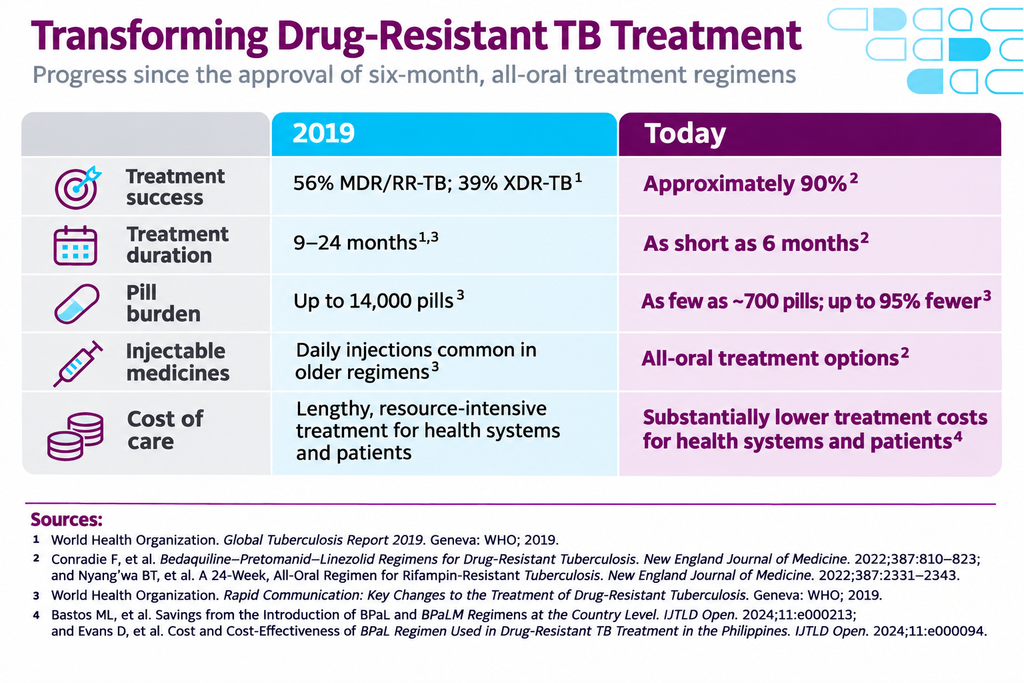
Our experience with pretomanid, a TB Alliance-developed medicine used in the shorter, all-oral BPaL and BPaLM regimens for drug-resistant TB, demonstrates the impact of this approach. Since pretomanid’s first regulatory approval in 2019, TB Alliance and its partners have helped achieve one of the fastest and widest introductions of a new TB medicine in recent history.
- Lower prices: At launch, pretomanid had the lowest LMIC access price among new TB treatments introduced in the modern era, and its price has subsequently fallen further by approximately 60% between 2023 and 2025.
- Global reach: As of mid-2026, approximately 310,000 pretomanid treatment courses (BPaL/M) had been procured across 140 countries – the fastest uptake seen for any new TB medicine in recent times. Neither price nor availability has been a barrier to accessing pretomanid in most LMICs.
- Faster uptake: Pretomanid reached broad global access in approximately three years, compared with the seven to nine years historically required for many new health innovations.
- Affordability: BPaL/M regimens are now available in most countries for less than $2 per day.
- Strong demand: In 2025, pretomanid shipment volumes reached approximately 80% of the estimated global market.
- Independent validation: External analyses, including research published in BMJ Global Health and an IQVIA evaluation, have highlighted the effectiveness of TB Alliance’s approach to accelerating access to new treatments.
Together, these achievements demonstrate how a carefully managed, competitive market can help ensure rapid, widespread availability, lower prices, and a high-quality, reliable supply.
Academic Study Finds TB Alliance’s Access Approach Successfully Accelerated Uptake of New TB Treatments
New Report: LIFT-TB Helped Cut Time to Global Uptake of Improved Drug-Resistant TB Treatments from Nearly a Decade to Three Years
TB Alliance’s DR-TB Treatment Rollout Recognized by WHO as Model for Responsible & Effective Antibiotic Introduction
Price of Key DR-TB Medicine Drops 25% as TB Alliance’s Multi-Manufacturer Strategy Expands Access