

- This event has passed.
Global TB Stakeholders 2026 Virtual Meeting
March 4 @ 8:00 am – 10:00 am
Global TB Stakeholders Meeting Charts Faster Route to Shorter TB Cures
TB Alliance’s 2026 Global TB Stakeholders Meeting brought together partners, advocates, and global health leaders with a focus on the promise of and significant progress in establishing a pathway to TB Alliance’s 1×1 vision for the future of TB treatment – one-month treatment for active TB and one-day treatment for latent TB infection. The event emphasized that such a vision can only be achieved by achieving and connecting progress at all stages of product development and introduction and in partnership and collaboration with countries and the broader TB stakeholder community.
The meeting opened with Mitchell Warren, the outgoing President of the Global TB Stakeholders and Executive Director of AVAC, reflecting on a global health environment marked by uncertainty and strain, but also by a renewed sense of possibility of aligning on what works and moving faster together. He then formally passed the leadership role to Dr. Doris Macharia, introducing her as the incoming President of the Global TB Stakeholders. Dr. Macharia is President of the Elizabeth Glaser Pediatric AIDS Foundation (EGPAF).
In her acceptance, Dr. Macharia emphasized the need to convert momentum in scientific progress into sustained collaboration—especially across high-burden settings—so that innovation does not remain confined to the pipeline, but reaches people quickly and equitably.
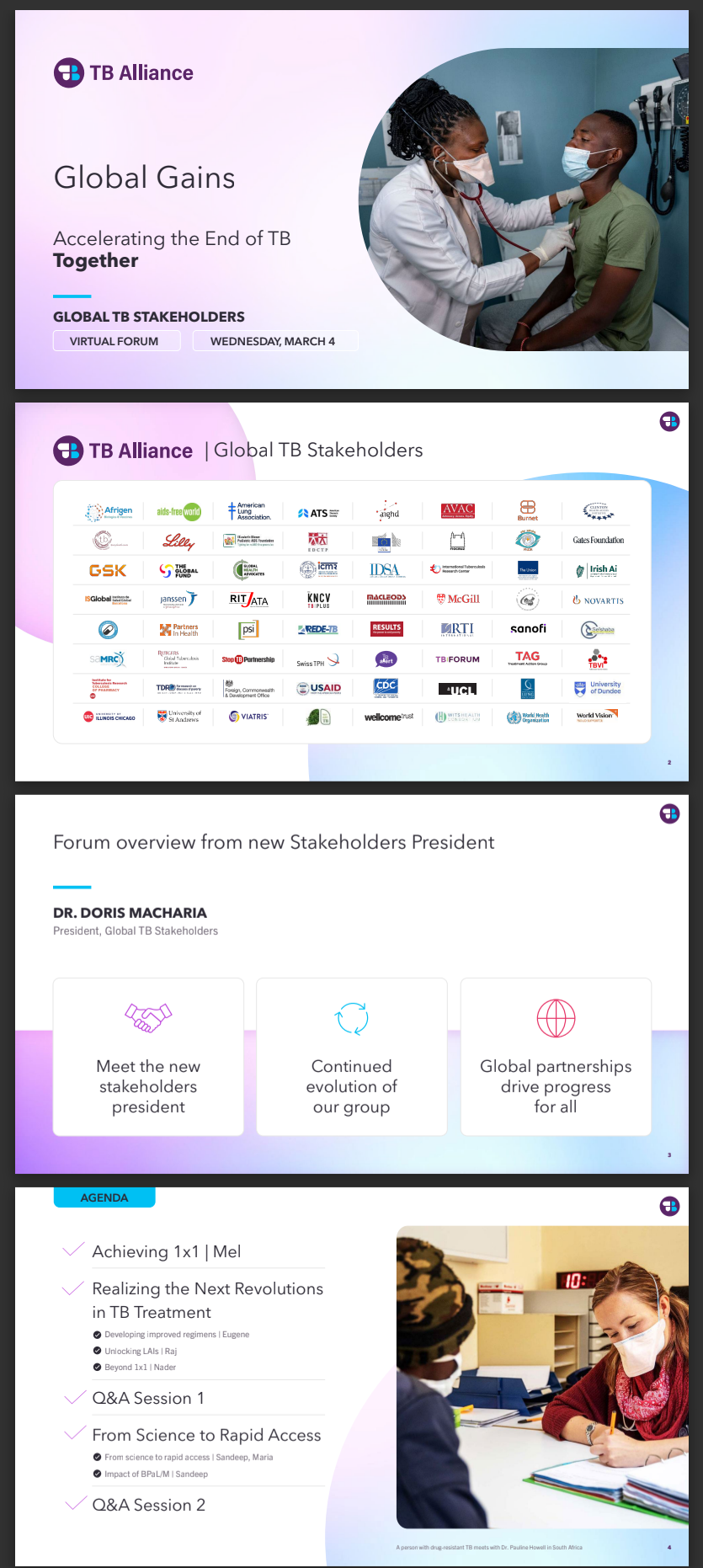
The scientific arc of the meeting followed the same logic: shorten, simplify, and strengthen treatment while ensuring the resulting advances are deliverable at scale. Dr. Mel Spigelman, President and CEO at TB Alliance reinforced both urgency and optimism in his opening remarks, noting that while pressures on global health are significant, the TB field is entering a period where the “future has never looked brighter” if progress continues across the development-and-delivery continuum. Dr. Spigelman concluded by tracing a strategic and scientific pathway to achieving TB Alliance’s 1×1 vision, which would be articulated in greater detail by subsequent speakers and rely on successes in drug development, introduction of innovative technologies, and a robust and responsive access program.
Dr. Eugene Sun, Senior Vice President of Research and Development at TB Alliance, then began to chart out the development path of TB Alliance’s late-stage drug candidate sorfequiline and the “SPaL” regimen. Dr. Sun recounted the path to global approval and endorsement of pretomanid as both a reminder of the task at hand and a source of learnings that are being applied to the development of sorfequiline.
Primarily by presenting results from the NC-009 clinical trial, a Phase 2 study of sorfequiline and the SPaL regimen, Dr. Sun highlighted sorfequiline’simproved potency and potential to reduce certain safety concerns relative to bedaquiline—one of the backbones of modern DR-TB treatment—thus positioning it as a key to future treatment shortening and simplification.
Dr. Sun reviewed plans for a Phase 3 study to compare a four-month SPaL/M regimen against six months of BPaL/M in a drug-resistant TB population, reflecting the program’s goal to pair scientific advancement with pragmatic learning that supports real-world adoption – including understanding performance in the context of resistance patterns.
Achieving 1×1 will ultimately require translating new, safer, and more potent TB drugs into long-acting injectable (LAI) formulations to enable dramatic leaps in treatment shortening. Dr. Raj Taneja, Vice President of Pharmaceutical Product Development at TB Alliance, made clear the transformative potential of LAIs and described an approach where latent TB could be diagnosed and treated on the same day with a single injection, and where active TB could combine an oral lead-in with long-acting formulations to simplify and shorten the burden of care. Importantly, the discussion emphasized that LAI development choices are being guided by what will be scalable and usable in high-burden settings – prioritizing affordability and adoptability, with an eye to manufacturing and regulatory pathways that can support wide access.
As the meeting agenda moved beyond near-term regimen gains, Dr. Nader Fotouhi, Senior Vice President and Chief Scientific Officer at TB Alliance, highlighted why a durable discovery engine remains essential, emphasizing that achieving ultra short treatments will require new mechanisms, smarter design, and—in some cases—finding alternatives to drugs whose toxicity or tolerability can constrain scale. He further highlighted the potential of host-directed therapies to enable significant treatment shortening and TB Alliance’s early-stage work to develop and apply these technologies. Dr. Fotouhi also reinforced TB Alliance’s intent and growing efforts to leverage emerging tools, including AI-enabled approaches, to accelerate identification and prioritization of targets and compounds in ways that can compress development timelines.
The meeting then pivoted from developing a new generation of TB treatments to ensuring that they reach all around the world who need them.
Sandeep Juneja, Senior Vice President of Market Access at TB Alliance, noted that by the end of 2025, pretomanid procurement volumes aligned with roughly 80% of the global demand for DR-TB therapy, while still challenging the community to compress timelines further – aiming for a future in which regulatory and policy milestones translate into near-immediate availability worldwide.
Mr. Juneja then described how TB Alliance is applying lessons through the rollout of pretomanid to guide the development and access approach to sorfequiline, including integrating affordability, acceptability, and cost-effectiveness planning earlier—during late-stage development rather than after approval—so countries are better positioned to adopt innovations without avoidable delay. He also underscored the benefits of closer collaboration with high TB burden countries across the product development pathway.
Maria Diachenko, Director of Market Access at TB Alliance, joined Mr. Juneja to highlight several key access initiatives developed through the introduction of pretomanid that can play catalytic roles in accelerating access to next-generation treatments. Presenters pointed to Fast Track the Cure’s role in advocacy and shared learning, PeerLINC’s peer-to-peer technical assistance model, and digital tools such as Upskill TB, reflecting an approach that treats community engagement and health-system readiness as core enabling conditions for impact – not add-ons.
Mr. Juneja concluded his presentation by sharing figures representing the impact of the BPaL/M regimens to date and projected over the next decade. The data, derived from a model developed by Johns Hopkins University, draws from real-world data as well as future projections, comparing a treatment environment with BPaL/M to a theoretical one that continues to use older therapies. Topline findings from the model include that the BPaL/M regimens have saved 11,000 additional lives and approximately $100M to date, and is projected to save nearly 200,000 lives and more than $1 billion over the next decade.
Before moving to a question and answer session, Dr. Spigelman concluded by emphasizing that progress in TB therapies, combined with advances in diagnostics and vaccines, makes a TB elimination agenda increasingly credible – provided the global community sustains partnerships and aligns around the full pathway from innovation to delivery. Dr. Spigelman argued that “now is the time” to chart a roadmap for TB elimination and even eradication as a real objective rather than a distant aspiration.
After the Q&A, Dr. Macharia closed the meeting. She noted that the Global TB Stakeholders group will offer additional deep dive webinars throughout the year and provided attendees an opportunity to weigh in on the topics they’d be most interested to learn more about.